The Life Savers

Together for a Healthier Tomorrow

The Life Savers Logo
The Life Savers
Blood donor connections · Lab tests · Home sample collection

Healthcare help that feels closer when every minute matters.

The Life Savers is a healthcare technology platform. It helps connect people who need blood with potential voluntary donors, and lets you book lab tests — with home sample collection where available — through labs on our network.
We are not a blood bank: we don't store or supply blood, and we can't guarantee a donor or a unit. In an emergency, contact the hospital or emergency services first.

Donor Community
Lab Network
Rewards

Who we are

What The Life Savers is — and isn't

The Life Savers is a healthcare technology platform. It helps connect people who need blood with potential voluntary donors, and gives access to lab and blood testing through a network of labs across India. These are two separate services in one account.

Blood donor connections

If you or your family need blood, you can post a request and registered donors with a compatible blood group nearby who have marked themselves available are alerted. If you want to help, you can register as a potential voluntary donor.

  • We connect people; we do not supply blood.
  • A donor connection doesn't guarantee that a donor or a unit of blood will be available.
  • Whether someone can donate is decided by the blood centre's doctor, not by this app.

Lab & blood testing

Search blood tests, diagnostic tests and health packages, book online, choose home sample collection where a lab offers it, and follow your order to the report.

  • Available across India through our network of labs — subject to the test or package, your pincode and the lab's availability. Not every test is available in every city.
  • Tests are performed and reports are issued by the labs; we don't interpret results.
  • We don't diagnose or recommend tests — your doctor decides which tests you need.

The Life Savers does not

  • Store, own or keep an inventory of blood
  • Operate a blood bank, or collect or process blood
  • Guarantee blood availability or a donor
  • Decide whether a donor is medically suitable
  • Replace hospitals, blood banks, blood centres, doctors or emergency services

In an emergency. In a medical emergency, contact the hospital or emergency services first. Use The Life Savers alongside them — never instead of them.

Why People Use The Life Savers

Most people come to The Life Savers at a stressful moment. These are the concrete things it helps with — and, just as important, what it doesn't do.

  • Search registered donors by blood group and location and contact them directly. Donors are voluntary, and we can't guarantee that anyone will be available.

    Sign in to search
  • Post a request with the patient's blood group, hospital, location and contact details. Registered donors with a compatible blood group nearby who are marked available are alerted.

    Sign in to raise a request
  • Plain-language guidance on who can donate, how long to wait between donations and what to expect, based on India's national guidelines. The blood centre makes the final decision.

    Read the guide
  • Search individual blood tests and health packages from labs on our network, and see the price before you pay.

    Browse lab tests
  • Where more than one lab offers the same test, compare price and report time side by side before you decide.

  • Choose home collection for eligible tests and pincodes to avoid a trip to the lab. Some items are lab-visit only.

The Life Savers is a technology platform, not a blood bank or a doctor. It doesn't guarantee that a donor or a unit of blood will be available, and it doesn't replace medical advice.

Our impact

What The Life Savers has done so far

Real numbers from the platform. They update automatically as people are helped and tests are completed.

Not available

People helped find blood donors

Not available

Tests completed

Loading… Baseline figures are recorded by The Life Savers team; growth since the baseline date is counted automatically from app records.

The Need

India's Blood Requirement at a Glance

India requires millions of units of blood every year. While collection continues to improve, maintaining an adequate and readily available supply requires continuous voluntary donation.

We're setting up these figures with the team — check back soon.

We're setting up these figures with the team — check back soon.

Two core services — blood donor connections and lab testing — plus the tools around them: alerts, reminders, reports and payments.

01

Donor Connections

Post a blood request with the hospital, location and contact details. Registered donors with a compatible blood group nearby who are marked available are alerted. We can't guarantee that a donor will be available.

02

Lab Test Booking

Book blood tests, health packages and diagnostic tests online from labs on our network. Prices are shown before you pay.

03

Home Sample Collection

Choose home sample collection where the lab offers it, so people can avoid unnecessary travel. Some offers are lab-visit only.

04

Digital Medical Reports

Receive lab reports in your account, ready to view and share with your doctor.

05

Secure Online Payments

Pay online with UPI, cards or netbanking or, where offered, pay when your sample is collected.

06

Live Community Chat

Stay connected with community updates, support conversations, and helpful care coordination when a request needs attention.

07

Educational Blogs & Health Tips

Read practical health tips, blood donation guidance, lab test awareness, preventive care notes, and wellness articles written for everyday users.

08

Timely Alerts

Receive important alerts for urgent blood requests, rewards, donation status, order updates, and nearby health camp announcements.

09

Donation Reminders

Get a reminder when your donation waiting period ends, so you can choose whether to make yourself available again.

10

Your Data & Privacy

Read our Privacy Policy to see what information we collect, how it is used and how it is protected.

11

Smart Location-Based Search

Find blood donors, lab tests, free health camps, and available services by city, district, state, pincode, and nearby location.

12

Donation Eligibility & Guidelines

Read India's national blood-donation guidance in plain language — who can donate, the waiting periods and what to expect. The blood centre makes the final decision.

13

Rewards & Scratch Benefits

Unlock location-based rewards, scratch benefits, health offers, and profile completion campaigns that encourage regular care.

14

Free Health Camps

Discover pincode-based free health camps, request available benefits, choose eligible checks, and track approval or fulfilment.

15

Donation Proof & Certificates

Submit proof of a donation. Once our team has reviewed it you get a certificate and badge, plus a date after which you may be ready to donate again.

16

Community

A community space where members can post messages and blood requests.

How The Life Savers works

Three things people come here to do. Each one below is how the app works today — nothing more.

I need blood

Ask registered donors near you for help — and keep working with the hospital's blood bank.

  1. Step 1: Sign in and open Community

    Choose ‘Need blood urgently?’. You need an account to post a request.

  2. Step 2: Fill in the three-step request

    Blood group and patient, hospital and location (including pincode), then a contact number and the time blood is needed by.

  3. Step 3: Compatible donors are alerted

    The request appears in Community chat, and registered donors with a compatible group who are marked available near you are alerted — by pincode first, then city, then district.

  4. Step 4: Donors call you; you close the loop

    Interested donors call the number on the request. Mark it fulfilled when you have the blood, or remove it.

We connect people; we are not a blood bank and can't promise a donor will be available. Blood is only issued by licensed blood centres, so also contact the hospital's blood bank.

I want to donate

Become discoverable when someone nearby needs your blood group — and keep a record of your donations.

  1. Step 1: Create your donor profile

    Add your blood group and location and choose whether you are available to help.

  2. Step 2: Check you can donate

    Read the India eligibility guide on this page. The blood centre's doctor makes the final decision on the day.

  3. Step 3: Donate at a licensed blood centre

    Donation happens at a licensed blood centre, hospital or camp — never privately arranged through an app.

  4. Step 4: Add your donation proof

    Upload proof of your donation. Once our team reviews and approves it, you get a certificate and your next eligible date.

Being registered doesn't oblige you to donate — you decide each time, and eligibility is always checked at the blood centre.

I want a lab test

Compare tests and packages, book with a partner lab, and follow the order to the report.

  1. Step 1: Find your test

    Search for a test or package, or browse by health concern. Compare what each includes and its price.

  2. Step 2: Choose a lab and add to cart

    Enter your details and pincode. Choose home sample collection where the lab offers it; some offers are lab-visit only.

  3. Step 3: Pay

    Pay online at checkout or, where offered, when your sample is collected, then follow the order from your account.

  4. Step 4: Get your report

    When the order shows ‘Report ready’, open the report from your order history. Your doctor should interpret the results.

We don't diagnose or recommend tests. Ask your doctor which tests you need.

One Platform. Many Moments of Care.

The Life Savers is a Made in India digital healthcare platform for people who need help quickly and want the process to feel clear.

The Life Savers connects people who need blood with potential voluntary donors, and lets you book lab tests online, with home sample collection where a lab offers it. Blood donor connections and lab testing are two separate services in one account — and we are a technology platform, not a blood bank or a doctor.

Whether you are looking for a donor near you, booking a blood test at home, or finding out who can donate in India, we want the next step to feel calm, clear and honest.

Donor

Match

Connection

Help

Blood in numbers

Why blood donation matters

Blood is needed after accidents, for surgery and cancer treatment, in complicated pregnancies, for anaemia, and for regular transfusions in conditions such as thalassaemia and sickle cell disease. It can only come from donors — it can't be manufactured. India's national guideline still describes the country as facing a shortage of safe blood, and asks for regular, voluntary, unpaid donors.[1]

National figures below — not The Life Savers' own data.

Every figure below has a named source and a year. Where sources differ or a number is an estimate, we say so.

  • ≈0.0 million units

    Estimated annual blood requirement in India

    NBTC's estimate as printed in the 2025 national guideline (the DGHS website states 14.6 million). National requirement estimation was carried out in 2016–17, so treat this as approximate.

    India2016–17 estimation[1][2]

  • 12.6
    14.6

    12.6 → 14.6 million

    Reported blood collections in India, 2023 → 2024

    Annual collections in units, as reported by authors from DGHS and WHO India. Collections and the requirement estimate come from different sources and years, so they can't simply be subtracted to give a shortage figure — blood is also needed in the right place, group and component, and platelets last only 5 days.

    India2023–2024[3]

  • 0.00%

    Share of India's collections from voluntary donors

    For 2025 (January to October). The remainder came from replacement donors — family or friends of the patient.

    India2025 (to October)[3]

  • Over 0%

    Share of worldwide donations that were voluntary and unpaid

    Of an estimated 120 million blood donations received in 2023, according to WHO.

    Worldwide2023[4][5]

Blood donation · India

Blood donation, explained

Clear, sourced answers for people in India who are thinking about donating — or about asking for blood. Follow your blood centre's advice if it differs.

Who can donate blood in India?

These are the whole-blood criteria in India's national guideline. They are general guidance: the medical officer at the blood centre checks you on the day and makes the final decision.[1][6]

The blood centre decides. The blood centre's medical officer makes the final call. The guideline can also be updated, for example during outbreaks or when new vaccines are introduced, so check with your blood centre before you go.

These are India's rules. These rules are India's. Eligibility rules are set nationally and differ between countries — the WHO's donor-selection guidance is written to help each country build its own — so don't apply rules you have read about elsewhere.

Donating platelets or plasma by apheresis has its own rules — for example, donors are 18–60 years old and weigh at least 50 kg.

When donation is usually postponed

10 common examples, with how long the guideline asks people to wait

Being told to wait is common and usually temporary. These are examples of how long the national guideline asks people to wait — not a complete list, and not a way to check yourself. Always answer the blood centre's questions in full.[1]

  • Cold, flu, cough or sore throat

    Usually wait: Until symptoms have gone and there is no fever

  • Fever with joint pain or a rash (cause not identified)

    Usually wait: 28 days after symptoms settle

  • Antibiotics

    Usually wait: 2 weeks after the last dose, if you are well

  • Tattoo, body piercing, acupuncture or a similar invasive cosmetic procedure

    Usually wait: 12 months

  • Dental treatment

    Usually wait: 48 hours after scaling or a filling · 14 days after a root canal or extraction · 12 months after a bone graft or reconstruction

  • Surgery

    Usually wait: 3 months after minor surgery · 12 months after major surgery (counted from recovery)

  • Having received a blood transfusion

    Usually wait: 12 months

  • Vaccination

    Usually wait: 14 days after non-live vaccines (for example tetanus or injectable polio) · 28 days after live vaccines (for example oral polio, measles or yellow fever) · 1 year after anti-rabies vaccination following an animal bite

  • Malaria, typhoid, dengue or chikungunya

    Usually wait: 3 months after recovery from malaria · 12 months for typhoid · 6 months for dengue or chikungunya

  • Pregnancy, childbirth, breastfeeding and menstruation

    Usually wait: 12 months after delivery (including while breastfeeding within that time) · 6 months after an abortion · while menstruating

Some conditions rule out donation for good, and some long-term conditions do not automatically rule you out. Only the blood centre's medical officer can tell which applies to you.

What to expect: before, during and after

Before

  • Eat a normal meal. Donors should not be fasting — the guideline suggests your last meal is about 4 hours before.[1]
  • Don't come to donate if you have been drinking alcohol or feel intoxicated.[1]
  • Be ready for honest health questions. They protect the patient and you, and donors are encouraged to share their full history.[1]
  • If your work involves flying, long-distance driving, diving, mining or other strenuous or hazardous duty, plan around it: donate no sooner than 12 hours after duty.[1]

During

  • You register and have a short talk about the process, what is tested and who may donate.[1]
  • A doctor reviews your health history and checks your weight, pulse, blood pressure, temperature and haemoglobin.[1]
  • You give written consent, understanding that donation is voluntary and unpaid and that your blood is tested for HIV, hepatitis B and C, syphilis and malaria.[1]
  • Blood is drawn by a qualified physician or trained phlebotomist at a licensed blood centre or camp — 350 ml, or 450 ml if you weigh 55 kg or more.[1]
  • The whole visit typically takes about an hour, and the donation itself usually 5–10 minutes (timings from NHS Blood and Transplant, UK). Tell the staff straight away if you feel unwell.[7]

After

  • Drink plenty of fluids, avoid heavy work, and don't smoke or drive immediately afterwards.[1]
  • Remove the adhesive dressing after about 6 hours.[1]
  • If your job is hazardous, don't return to it for at least 24 hours.[1]
  • Keep the blood centre's contact details and get in touch if you feel unwell or have any discomfort.[1]
  • Wait at least the minimum gap (3 months for men, 4 months for women) before donating whole blood again.[1]

How blood is kept safe

  • Every donation is tested for five infections — HIV, hepatitis B, hepatitis C, syphilis and malaria — before it can be used. WHO recommends that all donations are screened for HIV, hepatitis B, hepatitis C and syphilis.[2][5]

  • Blood may only be collected by a licensed blood centre, by a qualified physician or a trained phlebotomist under a physician's supervision. India had 4,484 licensed blood centres in 2025.[1][3]

  • Voluntary, unpaid donors are considered the safest source of blood. Paid ‘professional’ blood donation has been banned in India since a 1996 Supreme Court judgment.[1][2]

  • Donation is a safe procedure, but some donors can have a reaction such as fainting. Blood-centre staff are trained to spot and manage this, and donor reactions are reported to India's national haemovigilance programme.[1]

A whole-blood donation is separated into components so each patient receives only what they need. The national guideline says one donation can benefit several patients (3–4).

  • Red cells

    The part of blood matched to the patient's ABO and Rh blood group — see the compatibility chart below.[8]

  • Platelets

    Help blood clot. Needed in dengue, malaria, aplastic anaemia, some blood cancers, chemotherapy, surgery and bleeding. Platelets last only 5 days at a blood centre, so they must be replaced constantly. They can also be donated by apheresis, which takes about 1 to 1.5 hours.[1]

  • Plasma

    The liquid part of blood. Used, for example, when a patient lacks clotting factors. Stored frozen, it lasts up to a year.[1]

Myths and facts

  • Myth: You should donate on an empty stomach.

    Fact: Donors should not be fasting. The national guideline suggests your last meal is about 4 hours before donating.[1]

  • Myth: You can donate as often as you like.

    Fact: There is a minimum gap between whole-blood donations: 3 months (90 days) for men and 4 months (120 days) for women.[1]

  • Myth: Paying donors is a normal way to get blood.

    Fact: Paid ‘professional’ donation has been banned in India since 1996. Voluntary, unpaid donors are the safest source of blood.[1][2]

  • Myth: One blood group is the ‘best’ for every patient.

    Fact: Compatibility depends on the component. Red cells and plasma are matched differently, and each transfusion must be matched to the patient.[8]

  • Myth: Women can't donate blood.

    Fact: Women can donate if they meet the same criteria — age, weight of at least 45 kg and haemoglobin of at least 12.5 g/dL — with a longer minimum gap of 4 months, and with some temporary postponements around menstruation, pregnancy and childbirth.[1]

  • Myth: Anyone with a long-term condition can never donate.

    Fact: Some conditions do rule out donation, but others do not automatically. For example, the guideline can accept people whose diabetes is well controlled by diet or oral medication, or whose blood pressure is within set limits with or without medication, provided there are no complications. The medical officer decides.[1]

Not sure whether you can donate? Ask the blood centre or camp doctor — they decide. For more, read the full guide or our blog.

Blood group compatibility

This chart shows red-cell compatibility. It is for understanding only — the blood centre tests and cross-matches every unit, so never choose a donor for a patient on this chart alone.

Red blood cell compatibility: which blood groups each group can donate to and receive from
Blood groupCan donate red cells toCan receive red cells from
A+
A+AB+
A+A-O+O-
O+
O+A+B+AB+
O+O-
B+
B+AB+
B+B-O+O-
AB+
AB+
Everyone
A-
A+A-AB+AB-
A-O-
O-
Everyone
O-
B-
B+B-AB+AB-
B-O-
AB-
AB+AB-
AB-A-B-O-

Plasma follows different rules from red cells, and both blood and plasma transfusions must be matched to avoid a reaction.[8]

Browse by health concern

Not sure which test you need? Start with what's worrying you.

Start from what's on your mind. Each topic lists the tests doctors commonly use when looking into it, and the packages on our network that include them. It is a starting point for a conversation with a doctor — not a diagnosis.

These are general testing topics, not diagnoses. Talk to a doctor about your symptoms and about which tests, if any, are right for you.

Common tests, explained

Tap a test to see what it is, why a doctor may ask for it, how to prepare and where the information comes from. Home sample collection is available where the lab offers it.

Explanations are general information from the sources listed in each test. They aren't medical advice, and a test isn't necessary for everyone.

Bundled checkups for a complete picture

Want a broader picture instead of one test? These are the kinds of packages currently offered by labs on our network. Each card explains what a type of package is meant to cover; the exact tests and price depend on the lab and your location.

Featured package

Basic Health Checkups

A first-level screen of common blood and organ-function tests.

Roughly 30–90 parameters, depending on the package

CBCLiver Function TestKidney Function TestLipid ProfileThyroid ProfileFasting Blood Sugar+2 more

Extended Health Checkups

Broader packages that add more tests to the basics.

Roughly 65–100 parameters, depending on the package

CBCLiver Function TestKidney Function TestLipid ProfileThyroid ProfileIron Studies+9 more

Fitness & Wellness Packages

Men's and women's versions of a wellness bundle.

Two packages

CBCLiver Function TestKidney Function TestThyroid ProfileLipid ProfileHbA1c+7 more

Men's Health Markers

Packages that include testosterone or PSA.

Three packages

Testosterone TestPSA

Fever & Seasonal Infection Panels

A blood count grouped with tests for infections that can cause fever.

Five panels

CBCMalaria TestWidal TestESRUrine RoutineLiver Function Test

Allergy Panels

Panels that test reactions to lists of common allergens.

Five panels

Allergy Blood Test

Viral Screening (Rapid)

A rapid screen for HIV, hepatitis B and hepatitis C.

One panel (four tests)

HIV and Hepatitis B & C Screening

We only list package types that labs on our network currently offer. Contents, prices and availability differ by lab and location — check the exact inclusions before you book.

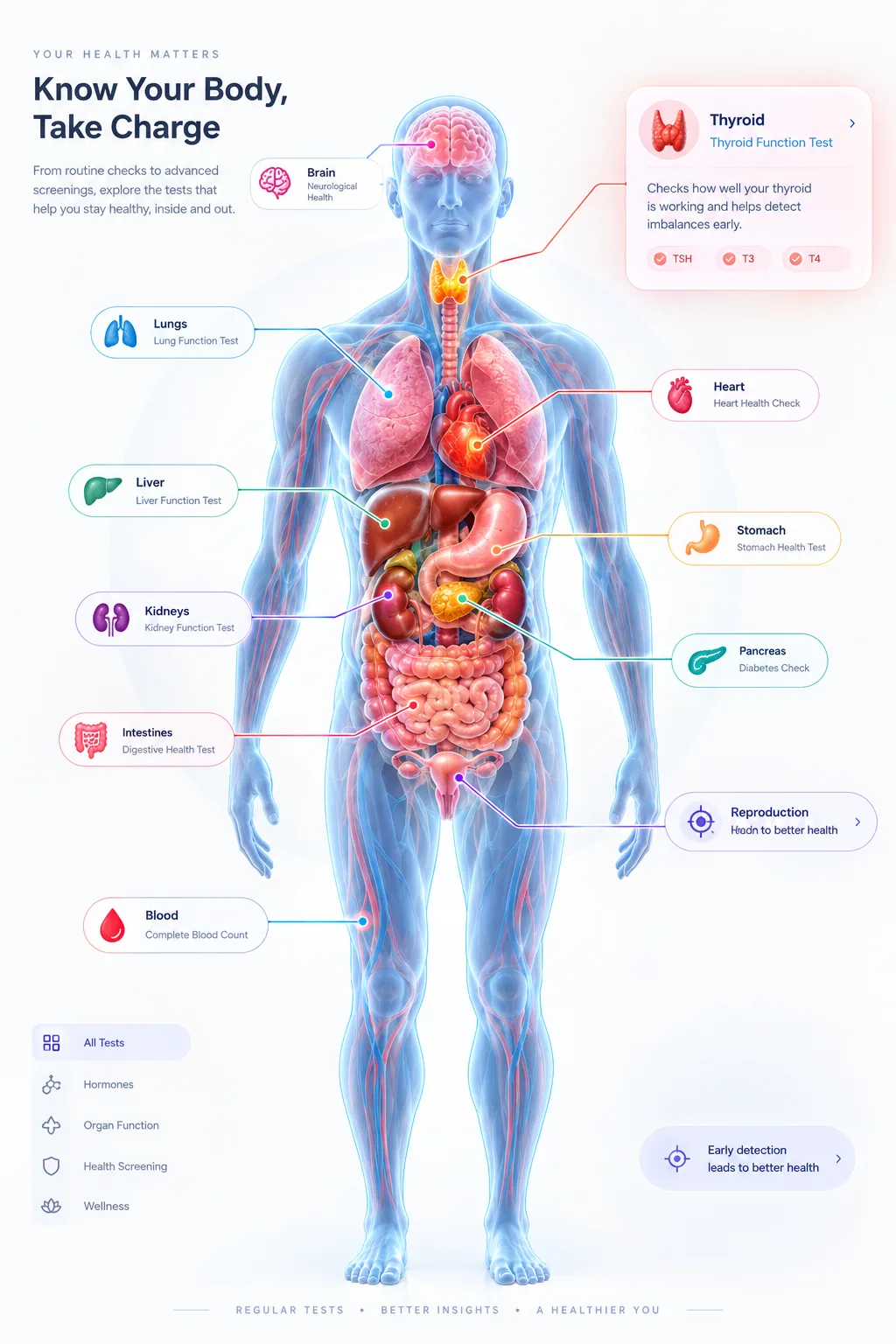
Focused on one system at a time

An organ-by-organ view: what each part of the body does and which tests on our network look at it. These are educational groupings — not diagnoses.

These are educational groupings, not diagnoses. Which tests suit you is something to decide with a doctor.

Trust & transparency

What you can check for yourself

Trust in a health service should rest on things you can verify. Here is what The Life Savers does today — and, just as important, what it doesn't.

  • Donation proof is reviewed

    A donation certificate is issued only after our team has reviewed the proof you upload. Your next eligible date is calculated from the approved donation.

  • Requests show who is asking and how to reach them

    Every blood request carries the hospital, location, contact number and needed-by time, and expires automatically. The requester can mark it fulfilled or remove it.

  • Honest results after you ask for blood

    After you publish a request, the app tells you how many donors were alerted — including when nobody could be reached.

  • Orders you can follow to the report

    Lab bookings can be paid online or, where offered, on sample collection, and move through visible statuses — from placed to report ready — with the report kept in your order history.

  • Policies you can read before signing up

    Our privacy policy and terms are public, and you can request a callback or contact support before creating an account.

    Privacy policyTermsContact us

What The Life Savers is not

  • Not a blood bank. Blood is collected and issued only by licensed blood centres, and we can't guarantee a donor or a unit will be available.
  • Not a doctor. We don't diagnose, recommend treatment or interpret your reports — that is for your doctor.
  • Not the judge of your eligibility. Whether you can donate is decided by the blood centre's medical officer on the day.
  • Not an emergency service. In a medical emergency, contact the hospital or emergency services first.

Watch how it works

See how care moves through the app

What Users Say

Stories Behind the Mission

A note from our founder, and stories from people who have used the app.

A Note From Our Founder

The purpose behind The Life Savers and the care we want to bring into every request.

Himanshu

Himanshu

Founder

“The Life Savers began with a simple thought: no family should feel alone while arranging blood, booking a test, or waiting for a health update. We are building this platform with patience, responsibility, and a deep respect for the people who choose to help strangers in difficult moments.”

What Users Say

Simple stories from people using the app for blood donor help, health checkups, and lab test booking.

Shivam

Shivam

User

“We needed A+ blood for my uncle and did not know where to start. The Life Savers made the request clearer, faster, and less stressful for our family.”

Lakshay

Lakshay

User

“I booked a full body checkup from the app. The home sample collection was smooth, payment was simple, and the digital report reached on time.”

Read all app reviews

Made in India

Made in India, built for families who should never feel helpless.

The Life Savers is an Indian healthcare technology platform created for real Indian needs: connecting people who need blood with potential voluntary donors, and booking lab tests with home sample collection where available. From metro cities to smaller districts, our aim is to make it easier to know where to start.

For blood requests

Connecting people with potential donors, with clear request details.

For diagnostic testing

Lab test booking, home collection, digital reports.

For real recognition

Donation status, Life Saver badges, certificates.

Our Vision

From India, for a Healthier World.

We're building The Life Savers with a vision to connect donors, diagnostics, healthcare providers and communities through one trusted healthcare ecosystem — starting in India, with ambitions that reach far beyond borders.

india highlighted as today's covered area vision: global healthcare reach

current presence

india

healthcare ecosystem

services growing from india

vision horizon

entire world

india is highlighted

Building in India

india is the covered area where The Life Savers is present today with its healthcare services.

global vision

Connecting the World

our vision is to grow this healthcare ecosystem so it can eventually support people across the entire world.

Carry The Life Savers in Your Pocket

Carry The Life Savers in Your Pocket

Search for nearby blood donors, receive emergency alerts, book blood tests online, request home sample collection, track lab orders, view reports, and manage donation status from one simple and reliable mobile app.

Available on Android and iOS. Free to download, simple to use, and built for everyday Indian healthcare needs.

The Life Savers

Live care hub

One careful health journey

Smart care flow

FAQ

Frequently asked questions

Short answers to the questions people ask us most. Health answers follow India's national guideline and name their sources; answers about the app describe how it works today.

Blood donation

Who can donate blood in India?

Under India's national guideline, whole-blood donors are generally aged 18 to 65 (first-time donors up to 60), weigh at least 45 kg, have haemoglobin of at least 12.5 g/dL and are in good health on the day. The medical officer at the blood centre makes the final decision.[1]

Read the full donation guide

How often can I donate blood?

For whole blood, the national guideline sets a minimum gap of 3 months (90 days) for men and 4 months (120 days) for women. Donating platelets or plasma by apheresis follows different, shorter limits set by the blood centre.[1]

What happens before I donate?

You register, have a short talk about the process, answer a health questionnaire and are checked by a doctor — weight, pulse, blood pressure, temperature and haemoglobin. You then give written consent. Eat a normal meal beforehand; donors should not be fasting.[1]

Is blood donation safe?

Donation is a safe procedure when it is done at a licensed blood centre by trained staff. Some donors can feel faint or have a reaction, and staff are trained to manage this, so tell them straight away if you feel unwell. Every donation is also tested for HIV, hepatitis B and C, syphilis and malaria before it is used.[1][2]

Does donating blood hurt?

You may feel the needle when it goes in, but the donation itself should not be painful. Tell the staff straight away if you feel pain, dizziness or unwell. The whole visit typically takes about an hour and the donation itself usually 5 to 10 minutes, according to NHS Blood and Transplant (UK).[7]

What should I do after donating blood?

Drink plenty of fluids, avoid heavy work, and don't smoke or drive immediately afterwards. Remove the adhesive dressing after about 6 hours. If your job is hazardous, don't return to it for at least 24 hours. Contact the blood centre if you feel unwell.[1]

Can I donate if I am taking medication?

It depends on the medicine and the reason you take it. Under the national guideline, many common medicines such as vitamins and oral contraceptives are accepted, while antibiotics mean waiting 2 weeks after the last dose. Some medicines rule out donation, so tell the blood centre's doctor about everything you take — the decision is theirs.[1]

Can I donate if I recently had an illness?

Usually you need to wait until you have fully recovered. For a cold or flu that means until symptoms have gone and there is no fever. After malaria the guideline asks for 3 months, after dengue or chikungunya 6 months, and after typhoid 12 months, each counted from full recovery. The blood centre will advise you.[1]

Can I donate after a tattoo or piercing?

In India, the national guideline postpones donation for 12 months after a tattoo, body piercing, acupuncture or a similar invasive cosmetic procedure. Rules in other countries differ, so follow the Indian guideline and your blood centre.[1]

Can women donate blood?

Yes, if they meet the same criteria — age 18 to 65, weight of at least 45 kg and haemoglobin of at least 12.5 g/dL — with a minimum gap of 4 months between whole-blood donations. Donation is postponed during menstruation, and for 12 months after childbirth or while breastfeeding within that time. It is postponed for 6 months after an abortion.[1]

Which blood groups are compatible?

For red cells, O-negative can be given to any group and AB-positive patients can receive from any group; the chart on this page shows every pairing. Plasma follows different rules, and the blood centre always tests and cross-matches each unit, so a chart is for understanding, not for choosing a donor.[8]

What is the difference between whole blood, platelets and plasma?

Whole blood is the usual donation of 350 ml or 450 ml, which is separated into components so it can help several patients. Platelets help blood clot and last only 5 days at a blood centre. Plasma is the liquid part of blood, stored frozen for up to a year. Platelets and plasma can also be donated by apheresis, which takes about 1 to 1.5 hours.[1]

Blood requests on The Life Savers

How can I request blood on The Life Savers?

Sign in, open Community and choose ‘Need blood urgently?’. A three-step form asks who needs blood, where, and how donors can reach you. When you publish, the request appears in Community chat and an alert goes to registered donors with a compatible blood group who have marked themselves available near you. We connect people — we are not a blood bank, and we can't guarantee that a donor is available. Also contact the hospital's blood bank, and use the government's e-RaktKosh portal to look up blood centres.[9]

Open Community

What information is needed to request blood?

Blood group, patient name, number of units (1 to 10), hospital, state, district, city and pincode, a contact number, and the time blood is needed by, which must be at least 15 minutes ahead. You can add notes such as a landmark or ward. A new request can be published once every 15 minutes.

How does a donor respond to a blood request?

Matching donors can receive a notification and open the request in Community, which shows the hospital, location and needed-by time with a button to call the requester. Donation itself happens at the hospital or a licensed blood centre after its eligibility check — never privately arranged. The requester marks the request fulfilled when it is done.[1]

How does location affect donor discovery?

We alert matching donors by pincode first, then by city, then by district, using the location each donor saved in their profile. If no compatible, available donor is registered nearby, nobody may be alerted — after you publish, the app tells you how many donors were reached, or that none were.

Lab tests

How does lab test booking work?

Search for a test or package, choose a lab, add it to your cart and enter your details, including the pincode. Where the lab offers home sample collection you can choose it — some offers are lab-visit only. You pay online and can follow the order from your account.

Book a lab test

How do I choose a test or package?

Start from your doctor's advice or prescription and compare what each package includes and its price. We don't diagnose or recommend tests, and a booking is not a substitute for a doctor's consultation — your doctor decides which tests you need.

How do I receive my reports?

Each test shows its usual report time. You can follow your order through Placed, Order accepted, Sample collected, In progress and Report ready. When it shows Report ready, open the report from your order history. Reports come from the partner lab; we don't interpret results, so please discuss them with your doctor.

What should I check before booking a test?

Check that the lab serves your pincode, whether the offer is home collection or lab visit only, the total price, and any preparation instructions for the test — such as fasting — given by your doctor or the lab. Follow those instructions.

Sources

Where this information comes from

Compiled by The Life Savers from the official and peer-reviewed sources listed below. Last updated 26 September 2026. Eligibility information is for India.

  1. [1]Guidelines for Voluntary Blood Donation: Towards 100% Voluntary Blood Donation (opens in a new tab)

    Blood Transfusion Services Division, Directorate General of Health Services (DGHS), Ministry of Health & Family Welfare, Government of India, with the National Blood Transfusion Council (NBTC) · India · 2025

    What we used it for

    The donor selection criteria in this document follow the Drugs and Cosmetics Rules (second amendment, March 2020), as further revised and approved by NBTC in December 2024. This is the primary source for every eligibility, deferral and donation-process statement on this page. Accessed 26 September 2026.

  2. [2]Blood Transfusion Services (National Blood Transfusion Council) (opens in a new tab)

    Directorate General of Health Services, Ministry of Health & Family Welfare, Government of India · India · 2025

    What we used it for

    Source for the estimated annual blood requirement (14.6 million units), the mandatory screening of every donation for HIV, hepatitis B, hepatitis C, syphilis and malaria, and the 1996 Supreme Court ban on professional blood donation. Accessed 26 September 2026.

  3. [3]Safe blood, strong nation — The journey of India's blood transfusion services: Under Ministry of Health and Family Welfare, Government of India (opens in a new tab)

    Khobragade MP, Roy MP, Rao R, Kumar K, Gupta M, Sharma S. Asian Journal of Transfusion Science (peer-reviewed); authors affiliated with DGHS, MoHFW and WHO India Country Office · India · 2026

    What we used it for

    Published online 13 May 2026. Source for reported annual collections (12.6 million units in 2023 and 14.6 million in 2024), the voluntary share of collections in 2025 (through October) and the number of licensed blood centres. Accessed 26 September 2026.

  4. [4]Safe blood supply improves as voluntary donations exceed 85%, but many people still lack access (opens in a new tab)

    World Health Organization (news release) · Global · 2026

    What we used it for

    News release of 12 June 2026. Source for the share of the estimated 120 million donations received worldwide in 2023 that came from voluntary, unpaid donors. Accessed 26 September 2026.

  5. [5]Blood safety and availability (opens in a new tab)

    World Health Organization · Global · 2026

    What we used it for

    Fact sheet as updated on 12 June 2026, reporting 2023 data. Source for global donation volumes and WHO's recommendation that all donations be screened for HIV, hepatitis B, hepatitis C and syphilis. Accessed 26 September 2026.

  6. [6]Blood donor selection: guidelines on assessing donor suitability for blood donation (opens in a new tab)

    World Health Organization · Global · 2012

    What we used it for

    Written to help each country build its own national donor-selection system, which is why the eligibility rules on this page are India's and should not be mixed with another country's. Accessed 26 September 2026.

  7. [7]The donation process (opens in a new tab)

    NHS Blood and Transplant (United Kingdom) · United Kingdom · 2026

    What we used it for

    Used only for how long a donation visit typically takes and what to expect. These are process timings, not eligibility rules — UK volumes and eligibility differ from India's. Accessed 26 September 2026.

  8. [8]ABO incompatibility (opens in a new tab)

    MedlinePlus, U.S. National Library of Medicine (reviewed 1 May 2026) · Global · 2026

    What we used it for

    Source for red-cell compatibility between ABO groups and the statement that blood and plasma transfusions must each be matched. Accessed 26 September 2026.

  9. [9]e-RaktKosh: Centralized Blood Center Management System (opens in a new tab)

    Ministry of Health & Family Welfare, Government of India · India · 2026

    What we used it for

    The Government of India's portal for blood centres, described in the national guideline as providing real-time blood stock availability. Accessed 26 September 2026.